Key Takeaways
A ceremony arch should feel connected to its venue, season, and wider wedding styling rather than looking like a separate decoration. Thoughtful planning also keeps the flowers practical, photographable, and manageable within the budget.
- Choose an arch structure that suits the ceremony space and overall wedding style.
- Use seasonal, sturdy flowers and foliage suited to an outdoor Hobsons Bay setting.
- Balance full floral coverage with focused arrangements at key visual points.
- Confirm measurements, access, installation, weather plans, and collection before booking.
- Compare florist portfolios and written proposals before securing the date.
Choose a ceremony arch style that suits your venue
The best ceremony arch is not always the largest one. Its shape, material, and placement should work with the architecture behind it, the available aisle width, and the way guests will move through the space. Begin by considering the venue before choosing flowers, because the structure creates the visual framework for everything that follows.
Freestanding floral arches for flexible placement
A freestanding arch is useful when the ceremony layout is not fixed or when the couple wants to frame a particular view. It can sit behind the celebrant, angle slightly toward the aisle, or be positioned to make the most of a garden, courtyard, or waterfront outlook. Ask how the structure will be weighted and whether its footprint leaves enough room for the wedding party to stand comfortably.
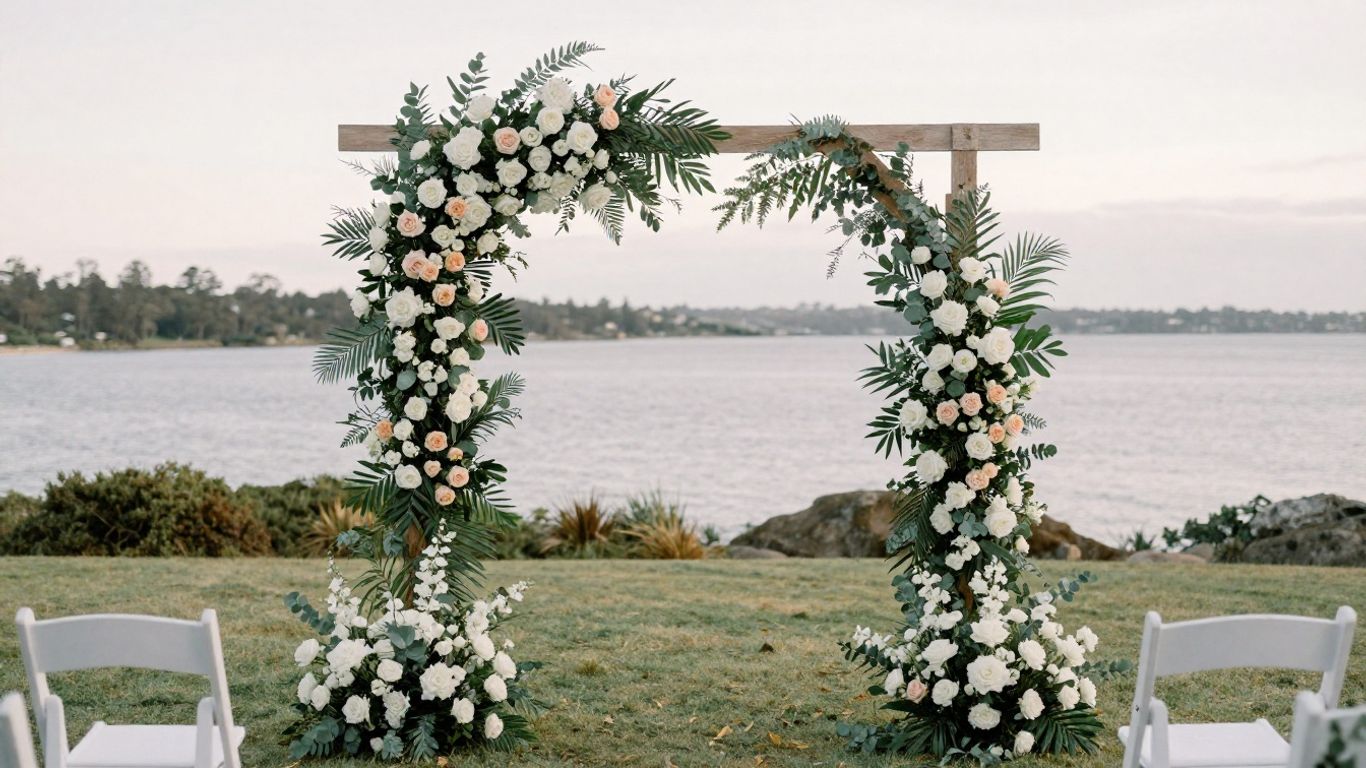
The flowers can be concentrated across the upper curve, gathered at both sides, or allowed to trail toward the ground. A balanced design usually looks more intentional than covering every inch without regard to the setting. Leave enough negative space for the venue to remain part of the photograph.
Wooden arbors for rustic and garden settings
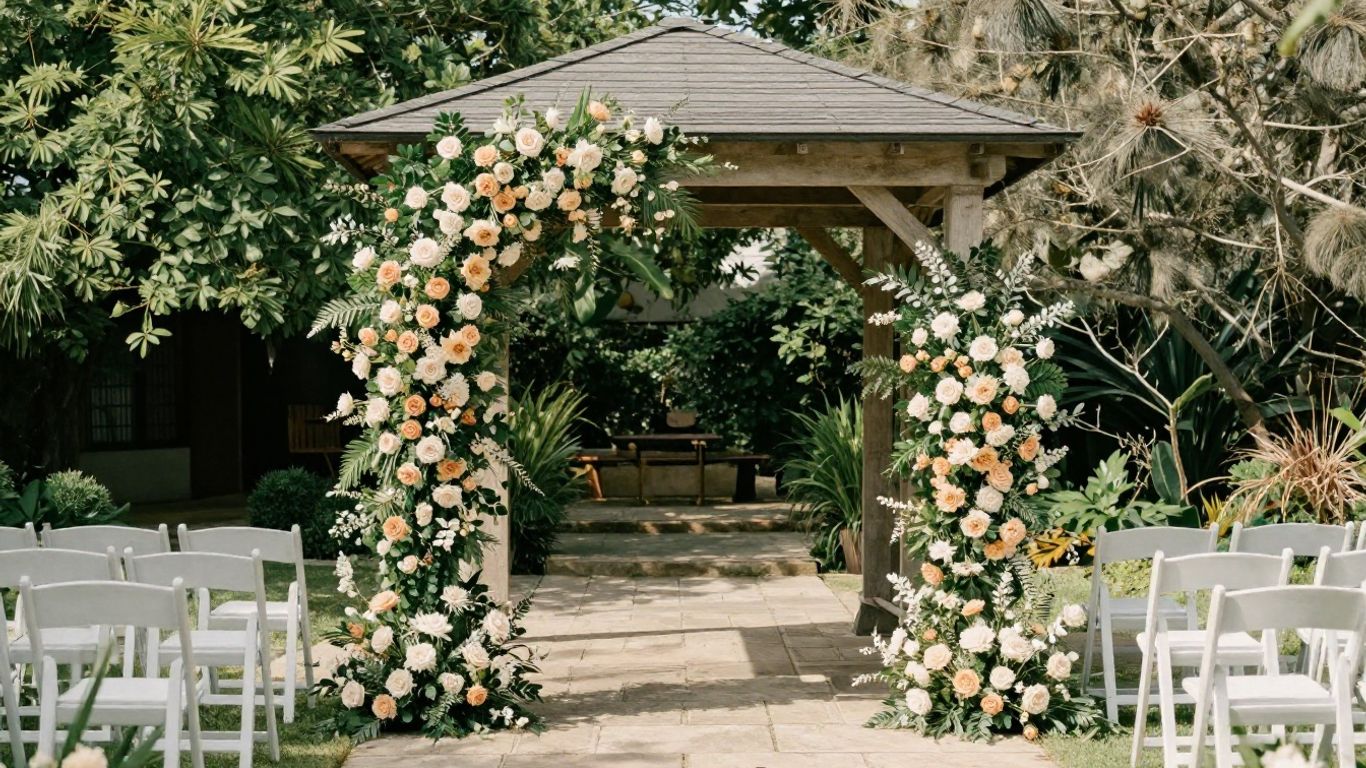
Wooden arbors bring warmth to lawns, gardens, and venues with natural textures. Their straight posts and open roofline provide a calm base for climbing foliage, loose flowers, or fabric details, while the timber itself adds visual weight even before the florist begins installing.
Choose the timber tone with the venue in mind. Pale wood suits soft garden palettes, while darker finishes can work well against stone, brick, or dense greenery. Flowers do not need to cover the entire arbor; a corner arrangement can look relaxed and still give the ceremony a clear focal point.
Asymmetrical designs for a modern look
An asymmetrical arch places most of the floral volume on one side, often with a lighter sweep across the top or down the opposite post. The result feels contemporary because it avoids a perfectly mirrored outline. It also gives the florist more freedom to build height and movement where the ceremony photographs best.
This style benefits from a restrained colour story. A few strong shapes, such as tall stems, rounded blooms, and trailing foliage, are easier to read than a crowded mixture of every available flower. Discuss how the design will look from the guest seats as well as from the photographer’s main position.
Minimal greenery installations for understated ceremonies
For a pared-back ceremony, greenery can define the arch without turning it into a wall of flowers. Olive branches, slender foliage, vines, and textural leaves can soften a metal or timber frame while keeping the surrounding venue visible. A few flowers placed at the base or along one side can add colour without changing the quiet character of the design.
Minimal styling still needs structure. Tell the florist whether you want an airy, botanical effect or a more polished line of foliage. The distinction affects the choice of leaves, the density of the installation, and how much of the arch remains visible.
Select flowers for the Hobsons Bay climate and season
Hobsons Bay weddings may involve gardens, courtyards, waterfront locations, and exposed outdoor spaces, so flower selection needs to account for more than colour. The season affects availability, while sun, wind, and transport affect how blooms hold up. A strong brief combines the desired mood with realistic choices for the date and ceremony conditions.
Seasonal flowers for better availability and value
Seasonal flowers are generally easier for a florist to source and can make the overall design feel more connected to the time of year. They may also offer better value than flowers that must be specially ordered or brought in from farther away. Rather than arriving with a fixed list of exact varieties, bring reference images and describe the colour, shape, and feeling you want.
A florist can then suggest close alternatives if a particular bloom is unavailable. That flexibility matters for wedding flowers because supply can change before the event. Confirm whether substitutions will keep the same palette and approximate scale, rather than assuming the replacement will look identical.
Hardy blooms for outdoor ceremonies
Outdoor flowers need to cope with handling, changing temperatures, and time away from refrigeration. Talk through the ceremony duration, transport distance, shade, and likely exposure before selecting delicate varieties. A hardy supporting mix can help protect the overall look even when one feature bloom is more sensitive.
For an outdoor installation, consider these practical questions:
- Will the arch stand in direct sun or partial shade?
- How long will the flowers be installed before guests arrive?
- Can the structure be moved indoors if the weather changes?
- Which blooms will still look fresh during photographs and congratulations?
The answers help the florist build a design that is beautiful at the start of the ceremony and still presentable later. They also reveal whether the installation needs extra hydration, shade, or a shorter setup window.
Color palettes that complement coastal venues
Waterfront settings often provide blue-grey water, pale sky, weathered timber, stone, and changing afternoon light. Soft whites, blush, cream, sand, muted peach, and gentle greens can sit comfortably within that environment, while deeper tones create a stronger focal point. The right palette depends on the season and the venue’s existing finishes.
Avoid choosing colours from a screen alone. Ask to see examples in natural light, particularly if the ceremony will be photographed outdoors. A considered colour palette will keep the arch connected to the bridal party, stationery, and reception flowers without making every arrangement look the same.
Foliage choices for texture and structure
Foliage gives an arch its outline and helps flowers feel grounded. Rounded leaves can soften a formal structure, fine foliage can create movement, and larger leaves can provide a bold base behind smaller blooms. The florist should vary texture rather than adding greenery uniformly around the entire frame.
Think about the foliage from a distance. Fine leaves may disappear in wide photographs, while large or glossy leaves can become dominant. A mixture of scale usually gives the arch enough definition to read clearly without competing with the couple.
Match your arch flowers to the ceremony setting
The same floral recipe can look completely different in a waterfront garden, a heritage courtyard, or an indoor room. Look at the surfaces, sightlines, light, and existing landscaping before deciding how much volume the arch needs. The aim is to frame the ceremony while allowing the venue to retain its own character.
Styling arches for Williamstown and waterfront venues
Williamstown and other waterfront locations can offer broad views, historic textures, open lawns, and strong coastal light. An arch should enhance those qualities rather than blocking them. Low, open arrangements work well when the outlook is part of the ceremony, while taller floral movement can help define the couple’s position against a busy harbour or building backdrop.
Wind exposure deserves early attention at these venues. Ask whether the florist has a plan for anchoring the structure and whether certain flowers should be placed in more protected positions. For transport details around Williamstown and Hobsons Bay, couples may also consider wedding car hire when coordinating arrival times and photography movements.
Designs for gardens, courtyards, and heritage spaces
Gardens tend to reward loose, natural designs that echo nearby planting. Courtyards may need more vertical structure because walls and paving create a harder background. Heritage spaces often benefit from restrained colour and clear silhouettes, allowing brick, bluestone, timber, or architectural details to remain visible.
Take photographs from the ceremony position and from the back row before finalising the design. A floral cluster that looks generous up close may appear too small in a wide courtyard. Conversely, a dense arrangement can overwhelm a narrow garden path.
Creating a strong backdrop for photographs
Photographers usually need a clean visual frame behind the couple, but that does not mean the arch must be symmetrical or completely covered. Consider where faces will sit within the structure, whether the background contains distracting objects, and how the flowers will look in both close portraits and full-venue photographs.
Discuss the ceremony schedule as well. Flowers may appear different in morning shade, strong midday light, or late afternoon sun. If you are collecting visual references, an arts centre venue can also provide useful inspiration for thinking about colour, form, and the relationship between a structure and its surrounding space.
Coordinating the arch with aisle and table flowers
The arch should introduce the floral language used elsewhere, not repeat the exact same arrangement. If the arch has a large statement flower, the aisle can echo its colour in smaller clusters. Table flowers may then carry the foliage or texture through the reception in a quieter way.
Keep one element consistent across the day, such as the foliage, a signature colour, or a particular flower shape. This creates continuity without making the ceremony and reception feel like copies of each other. A local florist can also advise on whether the arch flowers can be moved or partially repurposed after the vows.
Plan the floral design around your wedding budget
Ceremony arch flowers can range from a few concentrated clusters to a large installation that covers most of a structure. The price reflects the amount and type of flowers, the mechanics, the structure, labour, delivery, setup, and collection. A useful budget conversation focuses on priorities rather than asking only for the cheapest possible version.
What affects the cost of ceremony arch flowers
Flower variety is only one part of the quote. The size of the arch, the density of the flowers, the distance to the venue, access restrictions, installation time, and whether the structure must be hired can all affect the final figure. A design with large, premium blooms may require fewer stems, while a delicate, detailed arrangement can take longer to assemble.
Ask for the quote to separate flowers, mechanics, structure hire, delivery, installation, and collection where possible. This makes it easier to adjust one part without redesigning everything. It also prevents a low initial figure from becoming difficult to compare with a more complete proposal.
Full coverage versus partial floral installations
Full coverage creates a dramatic floral wall, but partial coverage can direct attention more precisely and usually uses fewer materials. A concentrated corner, asymmetrical sweep, or two grounded arrangements may give the photographs enough colour and scale without hiding the venue.
Think about what guests will actually see. If the lower half of the arch is hidden by the wedding party, it may be sensible to place more of the budget at eye level and above. The florist can show how different coverage levels affect the shape before you commit.
Ways to reuse the arch at the reception
Reusing ceremony flowers can make a larger installation more worthwhile, provided the structure and venue access allow it. Ground arrangements may move to the entrance, bar, cake table, or head table. Flowers attached directly to an arch may need careful removal, and some blooms may not remain fresh after hours outdoors.
Plan the move before the wedding day rather than treating it as an afterthought. A reception team may need a clear pathway, extra labour, and a realistic transition period. If guests are moving straight from the ceremony, the design may need to remain in place until the room is ready.
Questions to ask Hobsons Bay florists about pricing
A clear consultation should leave you knowing what is included and what could change. Write down the answers so that proposals from different florists can be compared on the same basis. For broader event planning, resources such as a winter group venue guide can also prompt useful questions about access, capacity, guest comfort, and hosting logistics, even when the event itself is a wedding.
Ask whether the quote includes:
- The arch or arbor structure and its hire period.
- Delivery, setup, pack-down, and collection fees.
- Florist-approved substitutions if flowers are unavailable.
- Extra labour for moving flowers to the reception.
- Weather-related changes or cancellation conditions.
Once these details are written down, a smaller design can be compared fairly with a more elaborate one. The most useful quote is not necessarily the lowest; it is the one that makes the scope and responsibilities easy to understand.
Coordinate practical setup and venue requirements
Beautiful flowers still need a workable installation plan. Before confirming the design, check the ceremony footprint, access route, venue rules, power or shelter requirements, and the timing of other suppliers. Practical details are easiest to resolve while the florist can still adjust the structure and flower quantities.
Measuring the ceremony space before ordering
Measure the available width, height, and depth, then note anything that may affect placement, such as steps, ramps, garden beds, low ceilings, or narrow gates. Take photographs from the aisle and the celebrant’s position. These details help the florist judge scale more accurately than a verbal description alone.
Also ask how much clearance is needed behind the arch. The couple may need room to stand, the photographer may need an unobstructed angle, and guests should not brush against flowers as they pass. A small floor plan can prevent expensive changes on the day.
Securing floral structures safely outdoors
Outdoor structures should be stable without damaging the venue. The florist and venue should agree on suitable weights, fixing points, and placement before installation begins. Do not assume that a heavy flower arrangement alone will keep a tall arch secure in exposed conditions.
If the ceremony is near water or on an open lawn, ask what happens if wind conditions exceed the safe limit. The answer may involve moving the arch, reducing its height, changing the floral density, or using a more sheltered position. Safety should take priority over preserving the original sketch.
Planning delivery, installation, and collection
Confirm who will be onsite to receive the florist, where the vehicle can unload, and how long setup is expected to take. Some venues have strict bump-in windows or require suppliers to use a particular entrance. Include the celebrant, photographer, planner, and venue contact in the timing conversation where appropriate.
A written run sheet should show when the arch arrives, when it is dressed, when it is photographed, and whether it is moved after the ceremony. Couples arranging an overseas celebration can compare this level of coordination with Oahu beach wedding packages, where location, permits, vendor coordination, and timing are also central planning considerations.
Managing wind, heat, and changing weather conditions
Weather plans should be specific rather than simply stating that the ceremony will move indoors. Decide who makes the call, when the florist is notified, and whether the arch can fit through the alternate entrance. Heat may also affect flower selection, water access, and how long arrangements can remain in place.
Build a little flexibility into the design. A structure that can be moved, reduced, or positioned in shade gives the team more options. When conditions are uncertain, a well-supported partial installation may be more reliable than a large, delicate one.
Book a Hobsons Bay florist with confidence
Choosing a florist is partly about style and partly about communication. You want someone who understands the visual intention, asks practical questions, and explains what can change before the wedding date. Review the work carefully, then use the consultation to test how well the florist listens and translates your ideas.
Reviewing portfolios for ceremony arch experience
Look for complete ceremony installations rather than only bouquets or close-up flower photographs. Check whether the portfolio includes different structures, outdoor conditions, wide venue shots, and designs with varying levels of coverage. A florist who can show both full and restrained arches may be better placed to tailor the work to your space.
Notice the mechanics as well as the blooms. Strong portfolios show how flowers sit on the structure, how the base is finished, and whether the design remains balanced from several viewpoints. For local inspiration, Hobsons Bay florist arrangements may help you compare the overall feeling you prefer, though your own proposal should be specific to your venue and date.
Comparing consultations, quotes, and design proposals
A useful consultation should cover the ceremony location, guest count, structure, preferred colours, budget, timing, and weather plan. Afterward, the proposal should explain the design in enough detail that you can picture its scale. If two quotes use different terms, ask the florists to clarify rather than guessing what is included.
Keep references organised in one place. Alongside floral images, you may save practical planning material, such as an Audioread option for turning articles, PDFs, and emails into spoken audio while commuting or handling other wedding tasks. That tool is separate from floral design, but an organised reference process can make decisions less tiring.
Confirming flower substitutions and availability
Flowers are seasonal and supply can change, so every contract should explain how substitutions are handled. Ask whether the florist will preserve the colour palette, flower size, texture, or overall shape if a variety is unavailable. You can also nominate a few flowers that matter most and allow flexibility elsewhere.
Do not approve a proposal based only on a flower name. The same variety can look different by season and grade, and the final result depends on the full combination. A conversation about alternatives is more useful than a promise that every reference photograph will be reproduced exactly.
Finalizing the design timeline and booking details
Secure the date once the design, scope, payment schedule, cancellation terms, access arrangements, and weather plan are clear. Keep the final proposal, venue contact details, and approved substitutions together. A short confirmation several weeks before the wedding can catch changes to the ceremony location or schedule.
The last consultation is also a good time to confirm who owns or returns hired structures and whether flowers can be moved after the ceremony. If the wider wedding includes an elopement-style format, reading about intimate Melbourne ceremonies may offer ideas for keeping the floral setting personal without making it overly elaborate.
Conclusion
The most successful ceremony arch flowers Hobsons Bay couples choose are the ones that belong to the setting, season, and shape of the day. Start with the venue, make the flower plan flexible, confirm every practical detail, and choose a florist whose proposal is clear enough to trust.
Frequently Asked Questions
How much do ceremony arch flowers usually cost?
The price depends on the structure, flower varieties, coverage, labour, delivery, installation, and collection. Ask for an itemised quote so you can compare partial and full floral designs fairly.
Which flowers are best for an outdoor ceremony?
Choose flowers that can tolerate the expected temperature, handling, transport, and time outside. Your florist can recommend suitable seasonal varieties and supporting foliage for the date and location.
Should an arch be fully covered in flowers?
No. Full coverage is dramatic, but a partial or asymmetrical design can create a strong backdrop while preserving the venue and reducing material requirements.
Can ceremony arch flowers be reused at the reception?
Often, some arrangements can be moved to the entrance, cake table, bar, or head table. Confirm this before booking because moving flowers requires time, labour, and suitable access.
How far in advance should wedding arch flowers be booked?
Book once your date and venue are confirmed, especially for popular wedding seasons. Earlier planning gives the florist more time to source flowers, hire structures, and coordinate installation.
What should I send a florist before the consultation?
Provide the venue name, ceremony date, photographs of the space, approximate measurements, colour references, budget range, and any venue rules. A simple floor plan can also help the florist judge scale.
What happens if the weather changes?
Agree on a clear backup plan covering who makes the decision, when the florist is notified, and whether the arch can be moved or adjusted. The safest option may be a sheltered position or a smaller installation.